Home and Employer: The Complete Guide to Live-In Personal Assistant Arrangements

The decision to employ a live-in personal assistant is not one that most households arrive at lightly. Whether the arrangement is driven by the need for round-the-clock support, the practicality of having someone immediately on hand, or simply the economics of offering accommodation in lieu of a higher salary, the consequences of getting it wrong extend well beyond the workplace. When your employee also occupies your spare room, the stakes — legal, financial, and personal — are considerably higher than in a conventional employment relationship.
That said, live-in arrangements can be genuinely excellent for both parties when structured thoughtfully. This guide sets out the key areas every household employer must address before handing over a set of keys.
Understanding the National Minimum Wage in Live-In Contexts
One of the most common — and costly — misunderstandings among private employers concerns how accommodation affects National Minimum Wage obligations. Many assume that providing free housing effectively reduces the salary they are required to pay. The reality is more nuanced.
HMRC permits employers to offset accommodation costs against National Minimum Wage calculations, but only up to a prescribed daily rate known as the accommodation offset. For the 2024–25 tax year, this stands at £9.99 per day. If you provide accommodation at no charge, you may count this offset against the minimum wage calculation — but you cannot use it to reduce pay below the applicable minimum wage rate once the offset is applied.
In practice, this means that offering free accommodation does not give you licence to pay a significantly reduced wage. Employers must calculate carefully, and ideally take professional payroll advice, to ensure compliance. Underpaying, even unintentionally, exposes you to HMRC enforcement action and potential claims at an employment tribunal.
Defining Off-Duty Hours — and Enforcing Them
Perhaps the most persistent challenge in live-in arrangements is the erosion of boundaries between working time and personal time. When your PA lives in your home, the temptation — on both sides — to blur these lines is considerable. A quick request at 9pm, an informal chat that slides into task delegation, or an expectation that availability is effectively continuous can all accumulate into an arrangement that bears little resemblance to the agreed contract.
From a legal perspective, this matters enormously. The Working Time Regulations 1998 apply to live-in staff just as they do to any other employee. Workers are entitled to a minimum of 11 consecutive hours' rest in every 24-hour period, and average working hours must not exceed 48 hours per week (unless the employee has opted out in writing). Failing to protect these entitlements creates liability regardless of whether any formal complaint is made.
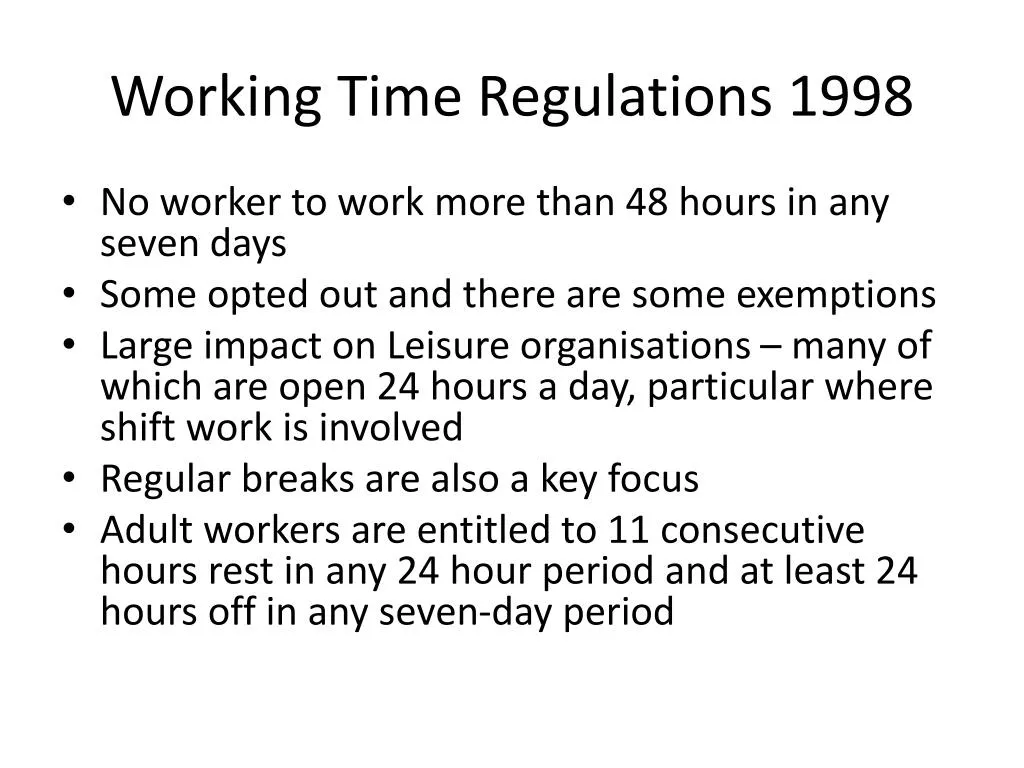 Photo: Working Time Regulations 1998, via image.slideserve.com
Your employment contract must specify working hours with precision. It should also make clear what constitutes a reasonable response to genuinely urgent situations outside those hours, and what does not. A written house agreement — separate from but complementary to the employment contract — can help establish mutual expectations around shared spaces, kitchen use, visitors, and quiet hours.
Tenancy Rights and the Right to Occupy
This is an area that surprises many employers. A live-in PA does not automatically become a tenant simply by virtue of residing in your property, but the distinction between a 'service occupier' and a tenant is not always straightforward, and it has significant implications for how you can bring the arrangement to an end.
A service occupier is someone who occupies accommodation as a necessary condition of their employment — typically because they genuinely need to live on the premises to perform their role. In such cases, the right to occupy the accommodation ends with the employment. However, if the accommodation is provided as a benefit rather than a contractual necessity, there is a risk that a tribunal or court could characterise the arrangement differently.
To protect your position, your employment contract should explicitly state that accommodation is provided solely for the purpose of facilitating the employment, and that the right to occupy ceases immediately upon termination or resignation. You should also take legal advice before proceeding with any eviction if a departing PA declines to leave voluntarily, as unlawful eviction carries serious consequences under the Protection from Eviction Act 1977.
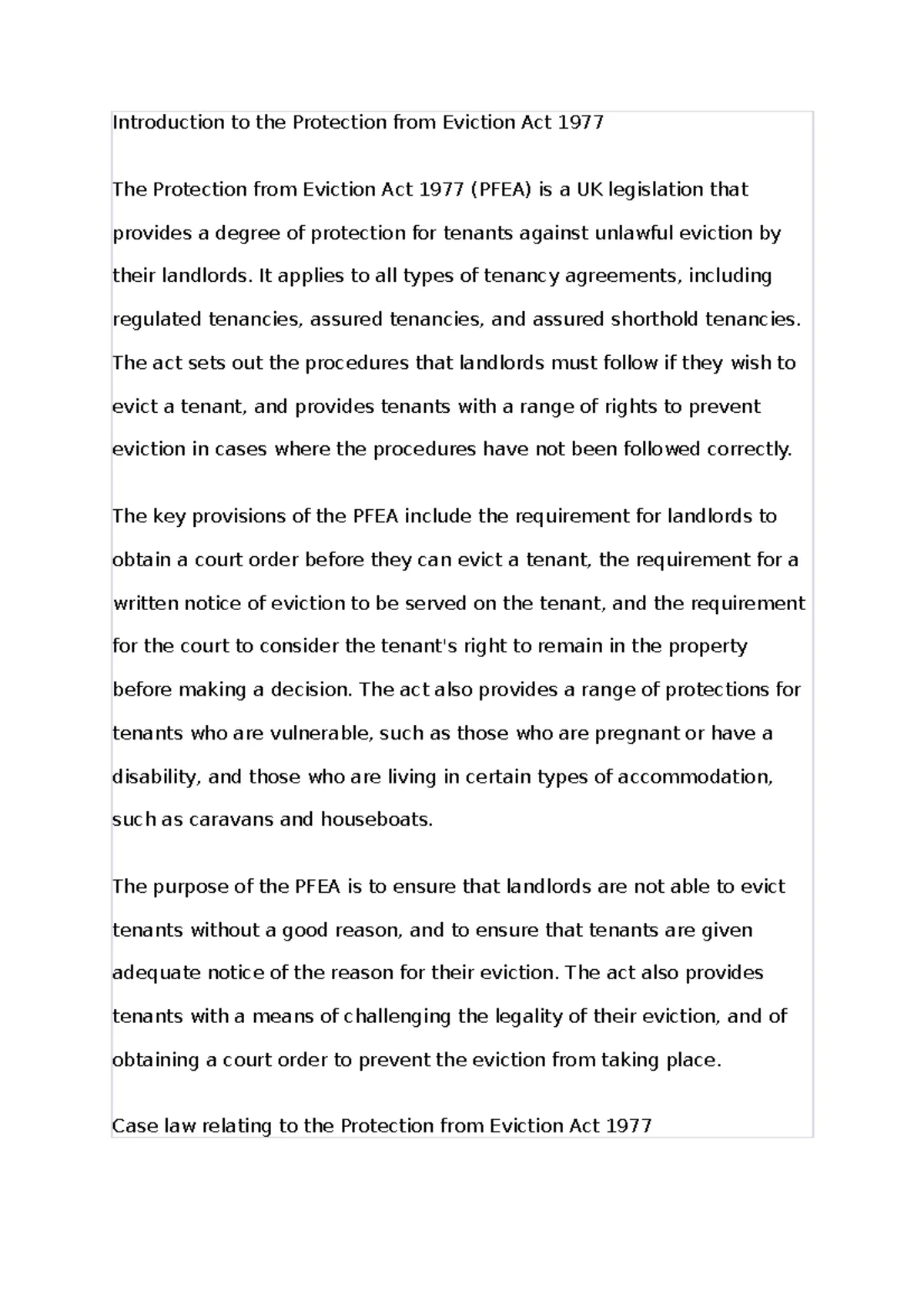 Photo: Protection from Eviction Act 1977, via d20ohkaloyme4g.cloudfront.net
Notice Periods and What Happens When Things End
The notice period in a live-in arrangement carries additional weight because it governs not just the end of employment but also the continued presence of the individual in your home. A standard notice period — typically one week during the first two years of employment, rising thereafter — may feel uncomfortably short or uncomfortably long depending on the circumstances.
Employers are advised to consider whether a longer contractual notice period is appropriate from the outset, particularly where the PA has significant access to the household, knowledge of routines, or care responsibilities for a vulnerable family member. Equally, a garden leave provision — allowing you to pay the notice period without requiring the PA to continue working — can be invaluable where the relationship has broken down and continued cohabitation would be untenable.
You should also plan in advance for the practicalities of departure: key return, access to digital accounts, and the removal of personal belongings. Addressing these matters in your written agreement before they become urgent prevents considerable conflict later.
Practical House Rules: A Foundation, Not a Formality
A written set of house rules is not a sign of mistrust — it is a professional framework that protects both parties. At a minimum, your house rules should address:
- Use of shared spaces: Which rooms are available to the PA, and at what times.
- Visitors: Whether the PA may have guests, and under what circumstances.
- Noise and quiet hours: Particularly relevant in households with young children or individuals with health needs.
- Kitchen and food arrangements: Whether the PA's meals are included, and how shared food is managed.
- Parking and vehicle use: If applicable.
- Pets: Responsibilities and restrictions.
These rules should be agreed before the PA moves in and incorporated by reference into the employment contract. They should also be reviewed periodically — particularly if circumstances in the household change.
The Genuine Benefits, Honestly Considered
It would be misleading to frame live-in arrangements purely as a compliance challenge. For many employers, particularly those with complex care needs or demanding schedules, having a PA in residence provides a level of support that is simply not replicable through other means. Response times are shorter, continuity of care is stronger, and the working relationship often develops a depth of understanding that benefits everyone involved.
For PAs, particularly those relocating to take up a role or those earlier in their careers, the provision of accommodation can make a position financially viable that would otherwise be out of reach. Approached with mutual respect and a solid legal foundation, live-in arrangements can be among the most effective and enduring in the sector.
The key is preparation. Employers who invest time in constructing the right contractual and practical framework before the arrangement begins are far better placed to enjoy its benefits — and far less likely to find themselves managing a crisis they were not equipped to anticipate.