Planning Ahead: How to Arrange Seamless Holiday Cover for Your Personal Assistant

The Problem With Last-Minute Cover
Annual leave is a statutory entitlement. Every personal assistant you employ has a legal right to take paid holiday, and as their employer, you are obliged to accommodate it. Yet a surprising number of private household employers treat this as an annual inconvenience rather than a foreseeable event requiring structured preparation. The result is a familiar cycle: a PA requests leave, the employer panics, and a hastily arranged substitute arrives with little briefing, unclear responsibilities, and no understanding of the household's routines.
The disruption this causes — to schedules, to care arrangements, to the general functioning of the home — is entirely avoidable. Building a robust holiday cover strategy is not an administrative luxury. It is a fundamental part of responsible household management.
Understanding Your Legal Baseline
Before exploring the practical options, it is worth clarifying the legal position. You cannot reasonably refuse a PA's holiday request simply because cover is difficult to arrange. While you do have the right to decline specific dates if they conflict with genuine operational needs — and to request that leave be taken at an alternative time — you cannot deny the entitlement itself.
Under the Working Time Regulations 1998, most workers are entitled to 5.6 weeks of paid annual leave per year. For a full-time PA working five days a week, that amounts to 28 days. Employers who fail to allow staff to take their full entitlement within the leave year may face claims at an employment tribunal, so proactive management of holiday scheduling is both practically and legally important.
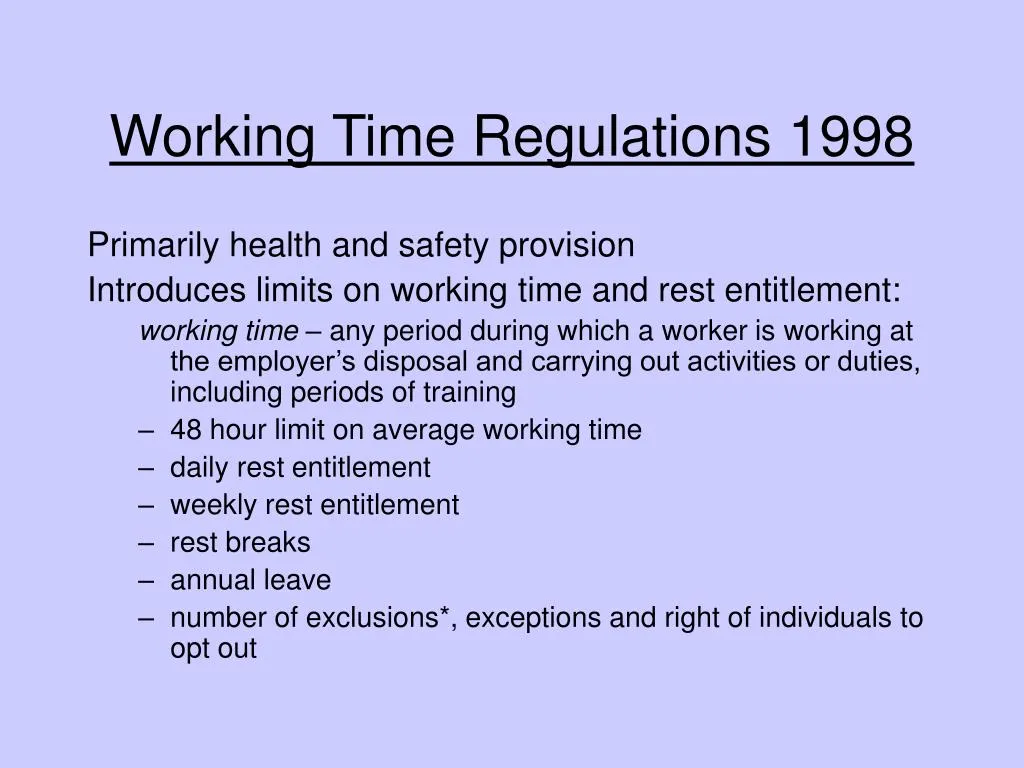 Photo: Working Time Regulations 1998, via image1.slideserve.com
If you employ more than one member of household staff, you may also need to consider whether simultaneous leave requests would leave you without adequate support. Addressing this in your employment contracts — by including a clause requiring advance notice of holiday requests and limiting the number of staff on leave concurrently — is advisable.
Option One: Temporary Agency Cover
For many employers, engaging a specialist domestic staffing agency to provide temporary cover is the most straightforward solution. Agencies that focus on household and private PA placements can often source experienced, vetted candidates at relatively short notice, though lead times vary considerably depending on the nature of the role and the level of skill required.
The key advantages of agency cover are speed and reduced administrative burden. The agency handles payroll for the temporary worker, manages employer liability in respect of that individual, and can often provide candidates with relevant experience. However, the costs are higher than employing a direct substitute, and there is an inevitable learning curve as the temporary worker familiarises themselves with your household.
To make agency cover as effective as possible, prepare a detailed household briefing document in advance. This should include daily routines, emergency contacts, any specific requirements relating to children, elderly relatives or medical needs, security codes, and the location of essential supplies. Handing this to a temporary worker on their first morning is far more productive than expecting them to absorb information verbally while managing competing demands.
Option Two: Cross-Training a Second Employee
If your household employs more than one member of staff — a housekeeper and a PA, for example — cross-training can provide a practical and cost-effective cover solution. This involves ensuring that a secondary employee has sufficient familiarity with the PA's core duties to step in for short periods.
Cross-training requires investment up front. It means dedicating time to shadowing, documentation, and practice before the need for cover arises. It also requires the willing participation of both employees, and should be introduced sensitively to avoid any implication that roles are interchangeable or that either position is under threat.
It is important to consider the employment implications carefully. If a housekeeper temporarily takes on PA duties that fall outside their usual job description, you may need to consider whether a temporary uplift in pay is appropriate, particularly if those duties are more demanding or carry greater responsibility. Taking legal advice before implementing such arrangements is prudent.
Option Three: Engaging a Known Casual Worker
Some employers maintain a small pool of trusted casual workers — former PAs, individuals known through personal or professional networks, or reliable candidates who were not selected at the original recruitment stage but made a strong impression. Engaging the same person repeatedly for holiday cover can create genuine continuity, as they build familiarity with the household over time.
If you take this approach, you must be careful about the employment status implications of repeated casual engagements. A worker engaged on a regular, recurring basis may acquire worker rights — including entitlement to holiday pay — even in the absence of a formal contract. Seeking HR or legal advice on how to structure casual arrangements appropriately will protect you from unintended obligations.
Building a Cover Plan Into Your Annual Calendar
The most effective household employers treat holiday cover planning as a recurring administrative task rather than a reactive emergency. At the start of each leave year, invite your PA to indicate their preferred holiday periods. This allows you to identify potential gaps early, begin sourcing cover well in advance, and discuss any scheduling conflicts calmly rather than under pressure.
Documenting this process — keeping a record of leave requests, approvals, and cover arrangements — also supports good practice should any dispute arise later. A simple spreadsheet or shared calendar can serve this purpose without requiring complex systems.
Finally, consider whether your household manual includes a section on cover arrangements. Clearly setting out the procedure for requesting leave, the notice period expected, and the employer's approach to sourcing substitutes gives your PA clarity and reinforces a professional working relationship from the outset.
A Final Word on Continuity
Holiday cover is not merely a logistical challenge — it is an opportunity to demonstrate that your household operates to a professional standard. A well-prepared substitute, a thorough briefing, and a smooth handover reflect well on you as an employer and reduce the likelihood of disruption. Investing time in planning now will pay dividends every time your PA takes the leave they have legitimately earned.