Protected Disclosures at Home: What Every Household Employer Must Know About Whistleblowing Law

Whistleblowing Is Not Just a Corporate Concern
Mention whistleblowing to most private employers and the reaction is often one of mild bewilderment. It conjures images of boardroom scandals and regulatory investigations — not the domestic setting of a family home. Yet the Public Interest Disclosure Act 1998 (PIDA) makes no distinction between the size of an employer or the nature of the working environment. If you employ a personal assistant, you are bound by this legislation in full.
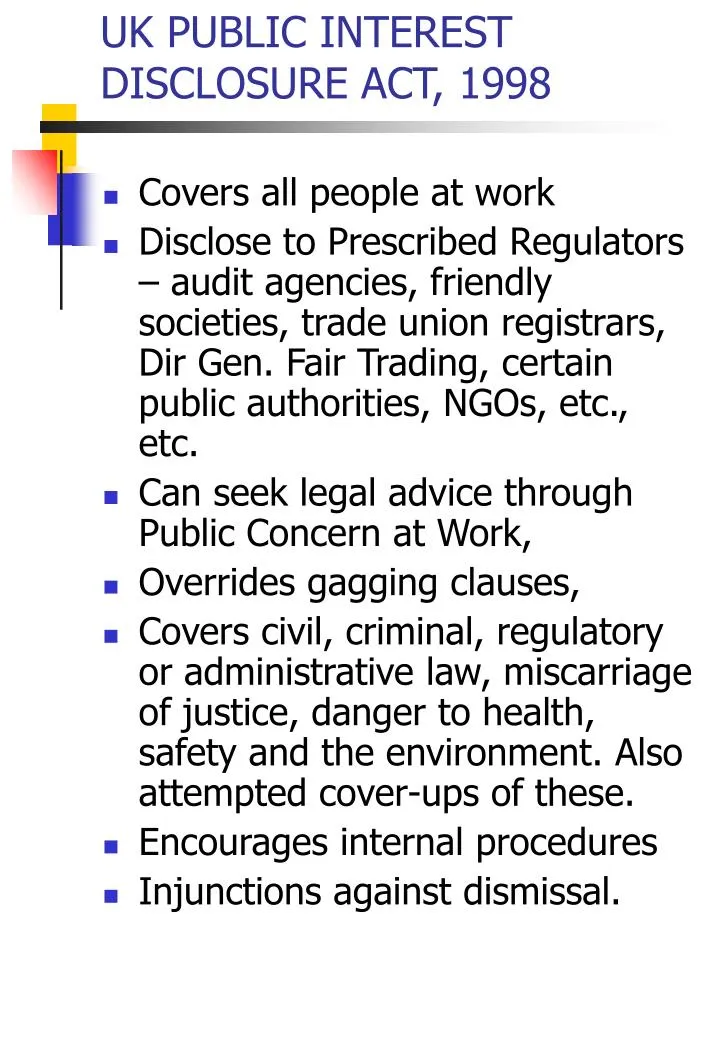 Photo: Public Interest Disclosure Act 1998, via image.slideserve.com
Understanding your obligations before a disclosure occurs — rather than scrambling to respond after one — is the mark of a legally sound employer. This article sets out the key principles, explores realistic household scenarios, and identifies the actions most likely to place you at legal risk.
What Counts as a Protected Disclosure?
A protected disclosure is a specific type of complaint or concern raised by a worker — referred to in law as a "qualifying disclosure" — that relates to one or more of the following categories:
- A criminal offence
- A failure to comply with a legal obligation
- A miscarriage of justice
- A danger to the health or safety of any individual
- Damage to the environment
- The deliberate concealment of any of the above
For a disclosure to attract legal protection, the worker must reasonably believe the information is substantially true and that raising it is in the public interest. This last element — public interest — is where household employers often assume they are exempt. The courts, however, have interpreted this requirement broadly. A personal assistant who raises concerns about unlawful practices within your home, such as underpayment of wages, unsafe working conditions, or the mistreatment of a vulnerable adult in your care, may well satisfy the public interest threshold.
Critically, the disclosure does not need to be made to an external authority to attract initial protection. A PA who raises concerns directly with you, their employer, may be making a protected disclosure.
Realistic Household Scenarios
To make this concrete, consider the following situations that could plausibly arise in a domestic employment context.
Scenario one: Your personal assistant raises concerns that a family member — perhaps an elderly relative in your care — is being treated in a way that constitutes neglect. Even if you dispute this characterisation, the PA's concern may constitute a protected disclosure relating to health and safety.
Scenario two: Your PA informs you that they believe they have been paid below the National Minimum Wage for a period of overnight duties. This relates to a failure to comply with a legal obligation and is likely to be a qualifying disclosure.
Scenario three: Your assistant expresses concern that a contractor regularly working in your home is engaged in fraudulent activity. Again, this could constitute a protected disclosure relating to a criminal offence.
In each case, the employer's instinctive response — whether defensive, dismissive, or retaliatory — will determine whether a legal claim follows.
The Dangers of Retaliation
PIDA protects workers from two categories of employer response: dismissal and detriment. Dismissing a PA because they have made a protected disclosure is automatically unfair, regardless of their length of service. This is a significant departure from ordinary unfair dismissal claims, which typically require two years of continuous employment before a worker can bring a claim.
Detriment is equally serious. If a PA is subjected to changed working conditions, reduced hours, a hostile working environment, or any other disadvantage as a consequence of raising concerns, they may pursue a claim at an employment tribunal. Compensation in whistleblowing cases is uncapped, meaning the financial exposure for a private employer can be substantial.
Perhaps most damagingly, retaliatory action is often unconscious. An employer who genuinely believes they are managing a difficult employee may, in the eyes of a tribunal, be penalising a whistleblower. This is why a structured, documented response is so important.
How to Respond When Concerns Are Raised
The appropriate response to a potential protected disclosure has several consistent elements.
Acknowledge the concern formally. Even in an informal household setting, it is important to confirm in writing that you have received the concern and that you are taking it seriously. A brief, factual email is sufficient.
Investigate proportionately. You are not required to conduct a full formal investigation for every concern raised, but you must take reasonable steps to consider whether the concern has merit. Document what you did and why.
Separate the concern from the relationship. If you have ongoing performance concerns about your PA, ensure these are handled through an entirely separate process. Conflating the two is precisely the kind of action that leads to tribunal claims.
Seek professional advice promptly. Where a concern touches on safeguarding, criminal conduct, or a serious regulatory matter, obtain legal advice before responding. Acting hastily in these situations frequently compounds the problem.
What You Cannot Do
The following actions are likely to constitute unlawful detriment and should be avoided entirely:
- Issuing a formal warning in close temporal proximity to the disclosure without an unrelated, documented justification
- Reducing the PA's hours or responsibilities without prior agreement
- Creating a working environment that is hostile, cold, or markedly different from the period before the disclosure
- Threatening consequences — explicitly or implicitly — for having raised the concern
- Dismissing the PA before following a fair process entirely separate from the disclosure
Building a Culture Where Concerns Can Be Raised
Larger organisations invest in whistleblowing policies and speak-up cultures. For household employers, the equivalent is simpler but no less important: a working relationship in which a personal assistant feels able to raise concerns without fear of personal or professional consequences.
This begins with the employment contract and staff handbook. Including a brief section acknowledging the right to raise concerns — and confirming that doing so will not result in detriment — sends a clear signal from the outset. It also provides documentary evidence, should a claim ever arise, that you took your obligations seriously.
Whistleblowing law may feel remote from the realities of domestic employment. The legal risk it carries, however, is very real. Employers who understand this legislation and respond to disclosures with care and structure are far better placed to protect both their household and their working relationships.